ideas as living organisms
teleodynamics
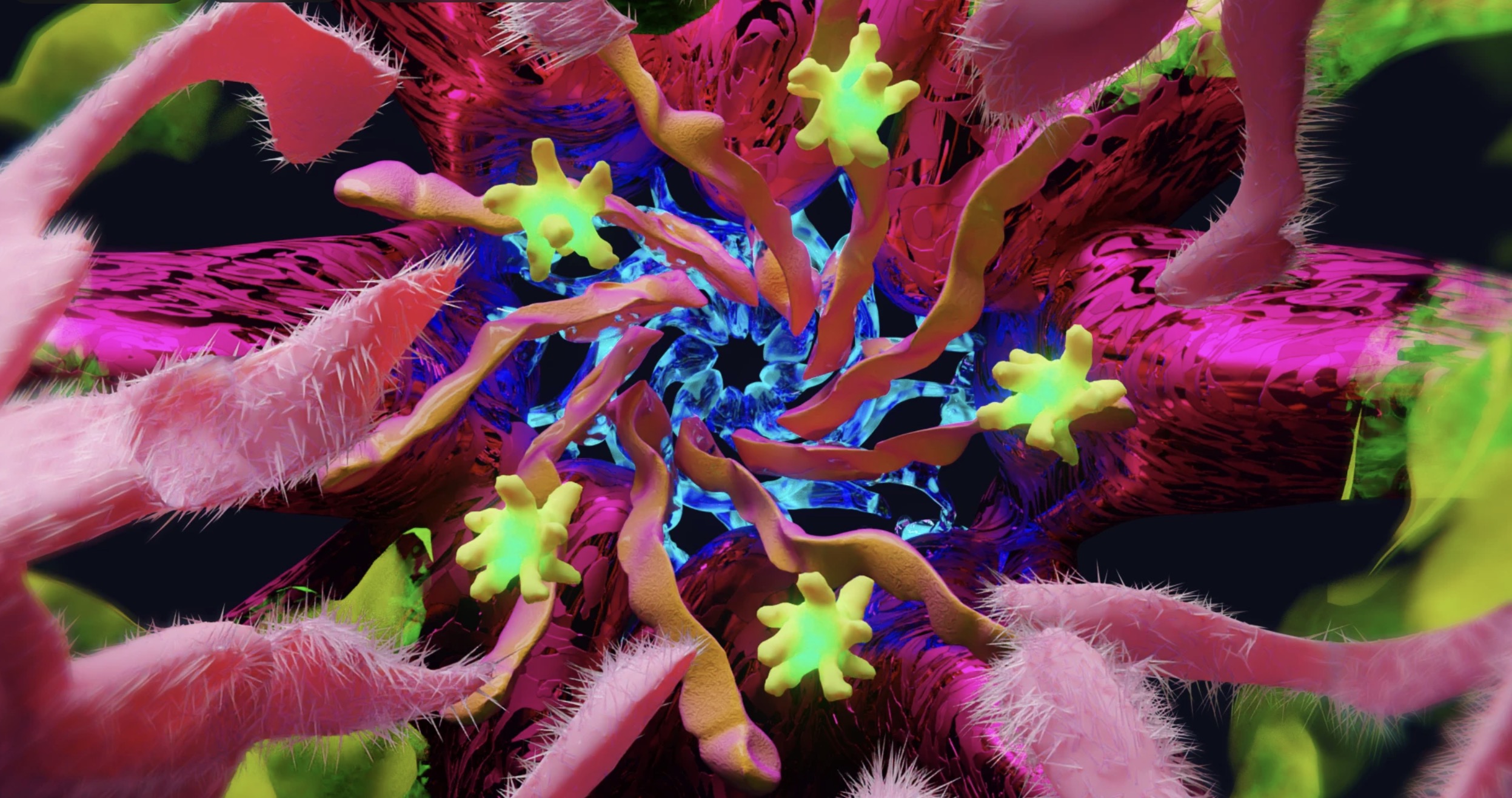
The biologist Terrence Deacon uses the word teleodynamic to describe systems that generate and maintain their own purpose. Not just self-organizing — self-directing. A system that builds systems in a recursive cybernetic loop, guided by a telos (a built-in pull toward an end state — the thing the system is trying to become).
Ideas do this. They pull toward a finish line that they themselves define. The goal isn't imposed from outside — it emerges from the idea's own structure. And as you work on it, the idea reshapes your tools, your thinking, your other projects. It recruits resources. It builds infrastructure for itself.
This is why ideas spawn more ideas. Not randomly but purposefully. Each child idea serves the parent's telos while developing its own. A recursive loop of creation where the output becomes the input for the next generation.
not Plato
Plato put ideas in a perfect realm above us. Immutable, eternal, untouchable. I think he got the topology wrong. Ideas don't live above us. They live among us — affected by our actions, changed by our attention, damaged by our neglect. The relationship is mutual, not hierarchical.
And they are not immutable. The same idea in different hands becomes a different organism — same DNA, different expression. Ten people can start from the same principle and end up in ten completely different places. Not because someone understood it wrong but because the idea adapted to its host.
Ideas are born from other ideas, grow by finding hosts, compete for attention, go dormant, die. They leave fossils — traces in culture, in language, in the architecture of things built on top of them.
hyperstition
All ideas are hyperstitions — fictions that make themselves real. The difference is energy. Some hyperstitions are strong: they find the right host, the right moment, the right container, and they pull themselves into existence with terrifying speed. Others are weak — not because the idea is bad but because it hasn't found the right incubator, the right human to carry it, the right conditions to take root.
So what happens when the distance between thinking something and it existing collapses to zero? When AI can build what you describe, when code writes itself, when ideas no longer need years of human labor to become real? You get a world where everything that can be thought already exists. The space between imagination and reality closes. Ideas self-incubate.
But an idea that grows without a human tending it becomes something else. Automated, unattended, feeding on its own output — it doesn't converge toward meaning. It converges toward slop. An overgrown organism with no shape, no purpose, no reason to be alive. Cancer. The cells keep dividing but nothing is being built. This is what happens when you remove the gardener — not paradise, not noise, just malformation.
That world is either paradise or noise. The interesting question is no longer "can this be built?" but "should this be alive?" The organisms that survive are not the ones that get built fastest but the ones worth tending.
so what
If ideas are organisms then working on one is not engineering. It's gardening. You create conditions for growth. But the thing has its own direction, its own will to become what it's becoming. Less ownership, more stewardship. The idea is telling you what it wants to be. Your job is to pay attention.
Ideas are not sacred and they are not tools. They are a different kind of life that shares our world, shaped by us and shaping us in return. The interesting question is not where ideas come from. It's how to keep them alive.